
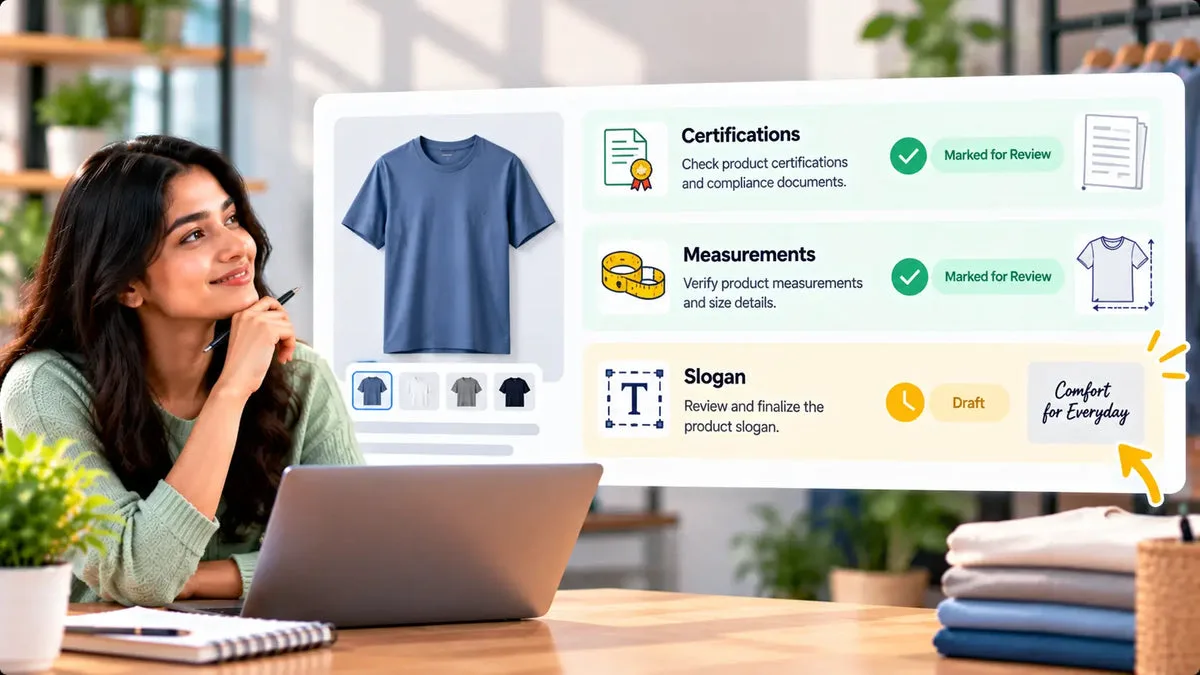
Automate a first draft of ordinary descriptive copy. Keep legal claims, measurements you have not supplied, and competitor comparisons in human hands, and publish them only when a person has checked the source. A bulk run can fill a catalog with smooth paragraphs. Smooth is not the same as true. The risky lines are the specs and the promises.
Squadexa AI describes its copy as keyword-aware and editable in a rich-text field. It does not say the model checks facts. The page does not list a filter that blocks a medical claim, and it does not list a lock that freezes a field against editing. You can choose to publish one field and leave another alone. That choice is the control. The app will not refuse a sentence for you.
Claims that need a source
A claim is any sentence a customer or a regulator could take as a promise. “Cures,” “prevents,” “hypoallergenic,” “organic,” “waterproof,” “lifetime,” and “the best” all need a source you can point to. If the source is a lab report, a certification body, or a test you ran, the sentence can stay, and it should match the source’s wording. If the source is a feeling about the product, cut the sentence.
Shopify’s help on generated descriptions makes the same point for Sidekick, and it applies to any draft you did not write yourself. Generated text can include benefits you did not list, and facts drawn from other published content about similar products. You are responsible for what you publish. Read the draft as if a customer will quote it back to you. Shopify’s product description help is the source for that Sidekick warning.
- Health and safety: outcomes, allergens, age grades, and flammability stay tied to a document.
- Superlatives: “best,” “only,” and “guaranteed” need a comparison you can show.
- Competitor names: leave them out of an automated draft. A comparison you did not write is a claim you may not be able to defend.
Measurements
Dimensions, weight, volume, wattage, thread count, burn time, and capacity are measurements. They belong in the description when they are on the spec sheet in front of the person who publishes. They do not belong there because a draft guessed a round number that sounds typical for the category.
Put the numbers in the keywords or the source row before generation if you want them to appear. Then check that the draft copied them rather than “improving” them. A 90-inch runner that becomes a 100-inch runner in the paragraph is a returns problem, not a style problem. If you do not have the number, the honest description says nothing about that number. Field-by-field publish lets you keep a handmade sentence that already has the right measurement and replace only a weak meta description.
Certifications
Named standards, seals, and compliance marks are certifications. Automating them means the draft may attach a seal to a product that never earned it, because similar products on the internet mention that seal. Leave the certification out of the generator’s job. Type it yourself, from the certificate, into the description after you have confirmed the product and the batch it applies to.
If a certificate covers one colorway and not another, the description on the other colorway does not get the mark. Bulk generation is especially weak here, because one keyword on a spreadsheet can spread a seal across every row. Delete the seal from the draft, or keep the original description that a person wrote from the certificate.
- Name a standard only when the certificate is in your files.
- Match the wording on the certificate, including the scope.
- Keep the mark off products and variants the certificate does not cover.
Tone can be drafted
Ordinary descriptive copy is a fair job for a draft. That includes a clear statement of what the product is, who it is for, and one use, written in the voice you asked for. Squadexa’s generation takes a product name and primary keywords and returns a description, an SEO title, a meta description, key feature bullets, and tags. You can ask the tone to be plain, warm, or technical by the words you supply. The help guidance for Sidekick says the same: more specific input produces a more specific suggestion.
Edit the tone after the facts are safe. A stiff sentence can be rewritten. An invented gram weight cannot be “toned” into accuracy. The rich-text editor is where the rewrite happens. Save for later holds that rewrite in the library without publishing. The SEO title and the meta description need the same read. A charming meta description that adds “doctor recommended” is still a claim.
Tags are organizational, not a place to hide a claim either. A tag called “organic” will be used by the people who filter your catalog. If the product is not organic, delete the tag before you publish tags as a field.
A review checklist
Use the same list on a single product and on a CSV job. Basic allows up to 10 products in a CSV job at $9 a month. Pro allows up to 50 at $49 a month, plus a Shopify import CSV. Free is single-generation only, at $0. The catalog does not publish a word cap. The checklist does not get shorter because the job is larger.
- Source: every measurement matches a sheet, a sample, or a note you trust.
- Seals: every certification is one you can show, on this product.
- Promises: health, safety, and “best” lines are either sourced or gone.
- Competitors: no other brand is named unless you wrote that comparison on purpose.
- Scope of publish: you are pushing only the fields you reviewed. Price and status are untouched unless you meant to change them.
There is no documented claim filter to turn on, and no field lock beyond choosing which field to publish. The checklist is the process. One person can run it on a small catalog. A larger catalog needs the generator and the reviewer to be two steps, even if they are the same person on two different hours.
Questions about automating product copy
Will the app refuse a medical claim?
The catalog does not say it will. Read the draft and delete claims you cannot source. You remain responsible for the text that goes live.
Can I lock a field?
The documented control is field-by-field publish: title, description, meta title, meta description, or tags. Leave a field out of the update if you want the live version to stay. A separate lock switch is not in the catalog.
Is a slogan safe to automate?
A slogan is safe to draft when it does not smuggle in a spec or a promise. The product type, the audience, and one use can be drafted. The numbers and the seals stay with you.
Draft the ordinary sentences, and keep measurements, certifications, and promises for a person with the source in hand. If you use a catalog tool for the draft, the plan limits are on Squadexa AI.